
10 ways AI can support learning and skills resilience (or not)
AI can do plenty in terms of learning and skills development – but educators and talent leaders also need to understand what AI tools should not be used for. ...

Don’t accept or reject AI recommendations indiscriminately: use your intuition as a litmus test. If something doesn’t feel right, go find out why. Allow your gut feeling to trigger deeper investigation.
Teach yourself and your team to ask, “Does this explanation make sense in our context?”, rather than, “Do I like this answer?”
Intuition often manifests as hesitation or discomfort. Normalize the idea that it’s okay to question AI outputs, especially when explanations don’t feel satisfying. This avoids both blind trust and reactive dismissal.
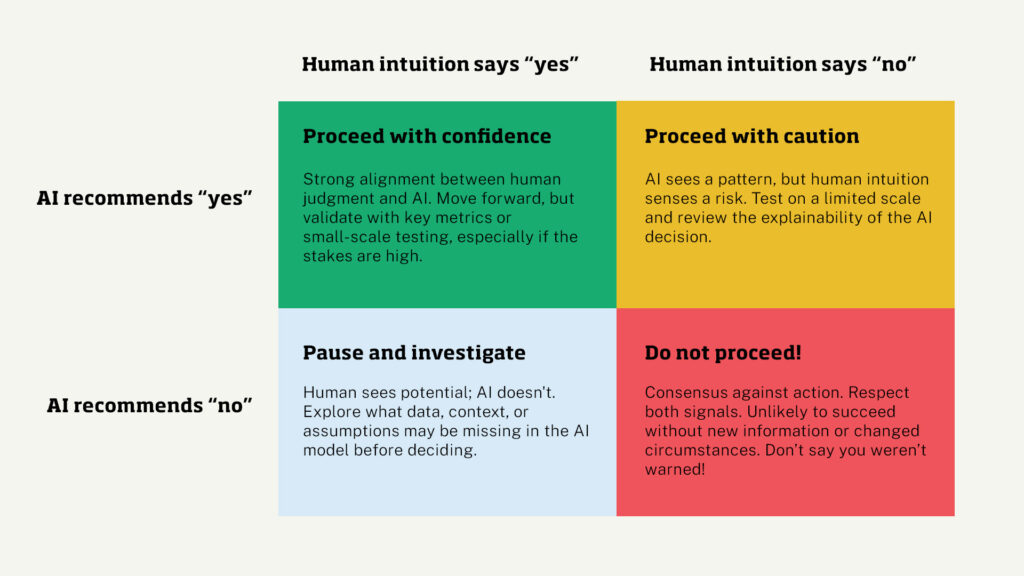
Humans often get it right when they question AI with good cause. Encourage teams to log and analyze instances where intuitive disagreement with AI led to better decisions, and build those patterns into future system design or training. The “traffic light” model below summarizes some tactics for managing situations when humans and AI agree or disagree.


AI can do plenty in terms of learning and skills development – but educators and talent leaders also need to understand what AI tools should not be used for. ...

A collaborative approach to training AI models can yield better results, but it requires finding partners with data that complements your own. José Parra-Moyano, Karl Schmedders, and Maximilian Werner set out the...

AI has the potential to become a super-useful teammate, but CHROs must manage its deployment with care. Answer the questions below to check how employees feel about its adoption and watch out...

AI and sustainability are transforming the business landscape, yet many organizations treat the two as separate mandates, led by separate teams pulling in different directions. Instead, they must integrate these forces, using...
Explore first person business intelligence from top minds curated for a global executive audience